Download MuleSoft Certified Integration Architect - Level 1.MCIA-Level-1.VCEplus.2024-07-10.68q.tqb
| Vendor: | Mulesoft |
| Exam Code: | MCIA-Level-1 |
| Exam Name: | MuleSoft Certified Integration Architect - Level 1 |
| Date: | Jul 10, 2024 |
| File Size: | 4 MB |
How to open TQB files?
Files with TQB (Taurus Question Bank) extension can be opened by Taurus Exam Studio.
Purchase
Coupon: TAURUSSIM_20OFF
Discount: 20%

Demo Questions
Question 1
A mule application is deployed to a Single Cloudhub worker and the public URL appears in Runtime Manager as the APP URL.
Requests are sent by external web clients over the public internet to the mule application App url. Each of these requests routed to the HTTPS Listener event source of the running Mule application.
Later, the DevOps team edits some properties of this running Mule application in Runtime Manager.
Immediately after the new property values are applied in runtime manager, how is the current Mule application deployment affected and how will future web client requests to the Mule application be handled?
- Cloudhub will redeploy the Mule application to the OLD Cloudhub worker New web client requests will RETURN AN ERROR until the Mule application is redeployed to the OLD Cloudhub worker
- CloudHub will redeploy the Mule application to a NEW Cloudhub worker New web client requests will RETURN AN ERROR until the NEW Cloudhub worker is available
- Cloudhub will redeploy the Mule application to a NEW Cloudhub worker New web client requests are ROUTED to the OLD Cloudhub worker until the NEW Cloudhub worker is available.
- Cloudhub will redeploy the mule application to the OLD Cloudhub worker New web client requests are ROUTED to the OLD Cloudhub worker BOTH before and after the Mule application is redeployed.
Correct answer: C
Explanation:
CloudHub supports updating your applications at runtime so end users of your HTTP APIs experience zero downtime. While your application update is deploying, CloudHub keeps the old version of your application running.Your domain points to the old version of your application until the newly uploaded version is fully started. This allows you to keep servicing requests from your old application while the new version of your application is starting. CloudHub supports updating your applications at runtime so end users of your HTTP APIs experience zero downtime. While your application update is deploying, CloudHub keeps the old version of your application running.
Your domain points to the old version of your application until the newly uploaded version is fully started. This allows you to keep servicing requests from your old application while the new version of your application is starting.
Question 2
A Mule application is synchronizing customer data between two different database systems.
What is the main benefit of using eXtended Architecture (XA) transactions over local transactions to synchronize these two different database systems?
- An XA transaction synchronizes the database systems with the least amount of Mule configuration or coding
- An XA transaction handles the largest number of requests in the shortest time
- An XA transaction automatically rolls back operations against both database systems if any operation falls
- An XA transaction writes to both database systems as fast as possible
Correct answer: B
Question 3
An organization has implemented a continuous integration (CI) lifecycle that promotes Mule applications through code, build, and test stages. To standardize the organization's CI journey, a new dependency control approach is being designed to store artifacts that include information such as dependencies, versioning, and build promotions.
To implement these process improvements, the organization will now require developers to maintain all dependencies related to Mule application code in a shared location.
What is the most idiomatic (used for its intended purpose) type of system the organization should use in a shared location to standardize all dependencies related to Mule application code?
- A MuleSoft-managed repository at repository.mulesoft.org
- A binary artifact repository
- API Community Manager
- The Anypoint Object Store service at cloudhub.io
Correct answer: C
Question 4
An organization has deployed both Mule and non-Mule API implementations to integrate its customer and order management systems. All the APIs are available to REST clients on the public internet.
The organization wants to monitor these APIs by running health checks: for example, to determine if an API can properly accept and process requests. The organization does not have subscriptions to any external monitoring tools and also does not want to extend its IT footprint.
What Anypoint Platform feature provides the most idiomatic (used for its intended purpose) way to monitor the availability of both the Mule and the non-Mule API implementations?
- API Functional Monitoring
- Runtime Manager
- API Manager
- Anypoint Visualizer
Correct answer: D
Question 5
How are the API implementation , API client, and API consumer combined to invoke and process an API ?
- The API consumer creates an API implementation , which receives API invocations from an API such that they are processed for an API client
- The API consumer creates an API client which sends API invocations to an API such that they are processed by an API implementation
- An API client creates an API consumer, which receives API invocation from an API such that they are processed for an API implementation
- The API client creates an API consumer which sends API invocations to an API such that they are processed by API implementation
Correct answer: C
Explanation:
The API consumer creates an API client which sends API invocations to an API such that they are processed by an API implementationThis is based on below definitionsAPI client* An application component * that accesses a service * by invoking an API of that service - by definition of the term API over HTTPAPI consumer* A business role, which is often assigned to an individual * that develops API clients, i.e., performs the activities necessary for enabling an API client to invoke APIsAPI implementation* An application component * that implements the functionality The API consumer creates an API client which sends API invocations to an API such that they are processed by an API implementation
This is based on below definitionsAPI client* An application component * that accesses a service * by invoking an API of that service - by definition of the term API over HTTPAPI consumer* A business role, which is often assigned to an individual * that develops API clients, i.e., performs the activities necessary for enabling an API client to invoke APIsAPI implementation* An application component * that implements the functionality
HOW TO OPEN VCE FILES
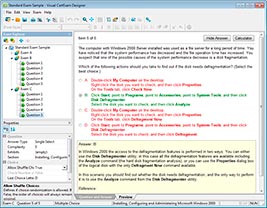
Use VCE Exam Simulator to open VCE files
HOW TO OPEN VCEX FILES
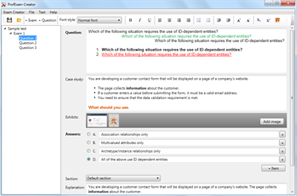
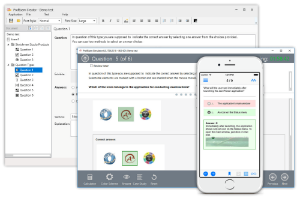
Use ProfExam Simulator to open VCEX files
ProfExam at a 20% markdown
You have the opportunity to purchase ProfExam at a 20% reduced price
Get Now!