Download ITIL Service Capability Operational Support and Analysis.ITILSC-OSA.PracticeTest.2018-08-01.10q.tqb
| Vendor: | ITIL |
| Exam Code: | ITILSC-OSA |
| Exam Name: | ITIL Service Capability Operational Support and Analysis |
| Date: | Aug 01, 2018 |
| File Size: | 1 MB |
How to open TQB files?
Files with TQB (Taurus Question Bank) extension can be opened by Taurus Exam Studio.
Purchase
Coupon: TAURUSSIM_20OFF
Discount: 20%
Demo Questions
Question 1
Which of the following is NOT an example of a Service Request?
- A user calls the Service Desk to order a toner cartridge
- A user calls the Service Desk because they would like to change the functionality of an application.
- A Manager submits a request for a new employee to be given access to an application
- A user logs onto an internal web site to download a licensed copy of software from a list of approved options
Correct answer: B
Question 2
Which of the following is NOT an objective of Service Operation?
- Thorough testing, to ensure that services are designed to meet business needs
- To deliver and support IT Services
- To manage the technology used to deliver services
- To monitor the performance of technology and processes
Correct answer: A
Question 3
Scenario
Brewster’s is a toy factory that has been in business for 30 years. The company started with a small family run shop and has grown consistently over the years. They are now supplying toy stores nationwide and are considered to be the primary supplier of children’s collectable novelty erasers.
Brewster’s IT department is relatively small (currently 15 staff) but efficient. They have recently employed an IT Manager in an attempt to improve the management of the infrastructure, as well as more effective use of resources and identification of areas for improvement.
The Brewster’s management teams do not have a lot of IT knowledge. The newly appointed IT Manager is very ITIL focused and wants to implement as many ITSM processes as is appropriate there are currently no formal processes in place. On starting with the company the IT Manager completed an internal assessment of the IT infrastructure – including staff skills analysis, and collated the results from customer satisfaction surveys completed over the last 5 years.
The main areas of concern are as follows:
Responses from customer satisfaction survey:
- Overall a consistent satisfaction level. However, responses completed during the past 12 months show an increase in customers who were unsatisfied with call waiting times when contacting the service desk for help with online orders and requests for information.
- Customers added the following additional comments:
- “Never get to speak to the same person twice when dealing with an Incident number, had to call several times to receive follow up on progress”
- “Some of the Service Desk staff seem under qualified to deal with my questions about new applications/incidents/service requests”
Results from Staff Skills Analysis:
- Staff, in general, have a good knowledge of IT systems and a basic understanding of the business processes and objectives. However, staff are not well informed of upcoming releases of new or changed services and not given adequate information to relay to the customers.
- Staff added the following additional comments:
- “Communication between Service Operation departments has become inefficient - there are meetings for the sake of meetings, but the important information we need to know to do our day to day jobs is lacking”
- “I still don’t know what half of the people do, that work in the IT department!”
Results from General IT Infrastructure assessment:
- Lack of event monitoring and planning
- Lack of input from Operational Support departments into Service Design
- Lack of skill and information sharing across the Operational Support teams with regards to Incident, Problem, Workarounds and Known Error data.
- Little to no proactive activities being carried out.
Refer to Scenario
Which of the following options would be most suitable to address the issues identified from the Customer Satisfaction Survey?
- You decide that the first two ITSM processes that need to be implemented are Incident Management and Request Fulfillment. As this will enable formal management and coordination of the Service Desk, and ensure that Incidents and Service Requests are dealt with accordingly, enabling separate logging and monitoring and faster call response times Send a formal memo to all customers, introducing yourself and your new role, thanking them for their valuable feedback and addressing the issues raised in the survey results and how you intend to resolve them.
- You decide that the first two ITSM processes that need to be implemented are Incident Management and Request Fulfillment. As this will enable formal management and coordination of the Service Desk, and ensure that Incidents and Service Requests are dealt with accordingly, enabling separate logging and monitoring and faster call response times. In addition, you will ensure that the new Incident Manager will ensure the Service Desk is the single point of contact, as a first priority. This needs to be the focus over the next quarter to ensure that this policy is adopted ASAP, you will suggest reward options to ensure that staff and end users are in no doubt that this is an essential requirement supported by senior management. Send a formal memo to all customers, introducing yourself and your new role. Thanking them for their valuable feedback and addressing the issues raised in the survey results and how you intend to resolve them.
- The results of this initial assessment are better than you had expected, you do not see any need to change things yet. You are not concerned with the additional comments as the general feedback is that customers are satisfied with the end to end service and that a 100% satisfaction is unrealistic. You will suggest to the Business that more staff is required for the Service Desk to ensure that call waiting times are reduced and that a more detailed and selective criteria is used as part of the selection process to ensure staff are at the correct skill level and competency.
- The results of this initial assessment are better than you had expected, you do not see any need to change things yet. You will suggest to the Business that it will be beneficial to complete another initial assessment in one year, after the next Customer Satisfaction Survey is completed, to compare the satisfaction levels and, if required, identify areas for improvement at that stage.
Correct answer: B
Question 4
Scenario
Brewster’s is a toy factory that has been in business for 30 years. The company started with a small family run shop and has grown consistently over the years. They are now supplying toy stores nationwide and are considered to be the primary supplier of children’s collectable novelty erasers.
Brewster’s IT department is relatively small (currently 15 staff) but efficient. They have recently employed an IT Manager in an attempt to improve the management of the infrastructure, as well as more effective use of resources and identification of areas for improvement.
The Brewster’s management teams do not have a lot of IT knowledge. The newly appointed IT Manager is very ITIL focused and wants to implement as many ITSM processes as is appropriate there are currently no formal processes in place. On starting with the company the IT Manager completed an internal assessment of the IT infrastructure – including staff skills analysis, and collated the results from customer satisfaction surveys completed over the last 5 years.
The main areas of concern are as follows:
Responses from customer satisfaction survey:
- Overall a consistent satisfaction level. However, responses completed during the past 12 months show an increase in customers who were unsatisfied with call waiting times when contacting the service desk for help with online orders and requests for information.
- Customers added the following additional comments:
- “Never get to speak to the same person twice when dealing with an Incident number, had to call several times to receive follow up on progress”
- “Some of the Service Desk staff seem under qualified to deal with my questions about new applications/incidents/service requests”
Results from Staff Skills Analysis:
- Staff, in general, have a good knowledge of IT systems and a basic understanding of the business processes and objectives. However, staff are not well informed of upcoming releases of new or changed services and not given adequate information to relay to the customers.
- Staff added the following additional comments:
- “Communication between Service Operation departments has become inefficient - there are meetings for the sake of meetings, but the important information we need to know to do our day to day jobs is lacking”
- “I still don’t know what half of the people do, that work in the IT department!”
Results from General IT Infrastructure assessment:
- Lack of event monitoring and planning
- Lack of input from Operational Support departments into Service Design
- Lack of skill and information sharing across the Operational Support teams with regards to Incident, Problem, Workarounds and Known Error data.
- Little to no proactive activities being carried out.
Refer to Scenario
Which of the following options would be the most effective option to address the issues identified from the Staff Skills Analysis?
- Organize a meeting with the managers of each IT department and form a Communication Plan. This plan will include all agreed methods, reasons and a list of personnel to be included for communications within the Operation departments. This plan will then be distributed to all staff, with a memo that will include;A photograph of each IT staff member with job title.Brief Job Description and explanation of their day to day activities.In addition, make a proposal to the Business that a Release and Deployment Manager is needed, this role will not only take on the responsibility of implementing a formal Release and Deployment process but will, manage the build, test and deployment departments and will also ensure that there is a consistent communication route to the service desk on upcoming releases and organizing training/knowledge updates and consultation with service desk staff on new or changed services.
- Organize a meeting with the managers of each IT department and form a Communication Plan. This plan will include all agreed methods, reasons and a list of personnel to be included for communications within the Operation departments. This plan will then be distributed to all staff, with a memo that will include;A photograph of each IT staff member with job title Brief Job Description and explanation of their day to day activities In addition, ask for the service desk to be sent copies of the release schedule so they are informed of upcoming releases.
- Recommend to the Business that a new staff training program needs to be implemented that will include one service desk member per week shadowing a member of staff in each of the Business Process areas to learn how they do things and what the business objectives are. In addition, request a weekly update from the build, test and deployment areas on any upcoming releases, including any relevant information that will enable the service desk staff to provide a better service to the customer.
- No immediate action required. You will work on a new training and communication policy that will formalize the process of communication and knowledge transfer between departments. You will also recommend that the first ITSM process to be implemented with be a formalized Incident Management process to ensure that effective measurements and analysis is taking place and that there is monitoring of staff competency and skill.
Correct answer: A
Question 5
Scenario
NEB is a financial management company that specializes in lending money for substantial property investments. They have a large IT department that is currently using the following ITSM processes:
- Service Level Management
- Availability Management
- IT Service Continuity Management
- Information Security Management
- Incident Management
- Problem Management.
Each of these processes have been implemented within the planned target time and are working effectively and efficiently. Staff have adapted to the changes in a very positive manner and see the benefits of using the ITIL framework.
Last Saturday, there was a security breach. A previous member of staff, who has left the company and joined a competitor organization, has been able to gain access to several client lending files. After initial investigation, it was found that access was not terminated when the staff member left the company – this has highlighted that there are insufficient processes in place to ensure access rights are terminated when staff leave the company, change roles etc and there is ongoing investigation to see how many other previous staff still have access to the system.
The business has requested immediate recommendations from the IT Manager, as to what can be done to ensure this situation does not happen again and how best to inform clients, with reference to the security breach.
Refer to the scenario.
Which of the following options is most suitable to deal with this situation?
- Your first recommendation is to implement the Access Management process as soon as possible. You suggest that as the IT organization has already effectively and efficiently implemented six processes, they will be able to manage a well executed and fast implementation. This process will ensure that access is provided to those who are authorized to have it and will ensure access is restricted to those who are not.With regards to informing clients, you recommend that clients are not told of the situation as you feel it will be too damaging to the NEB reputation and will result in a catastrophic loss of clientele. You suggest that if clients are contacted by the competitor organization, they cannot prove that any information has been obtained via NEB files and (as there is now a plan to implement Access Management) NEB can confidently reassure clients that there is ample security and access management in place to ensure this situation could never arise.
- Your first recommendation is to implement the Access Management process as soon as possible. You suggest that as the IT organization has already effectively and efficiently implemented six processes, they will be able to manage a well executed and fast implementation. As Access Management is the execution of the policies laid out within the Availability and Information Security Processes, the foundations are already laid. This process will ensure that access is provided to those who are authorized to have it and will ensure access is restricted to those who are not. To ensure alignment between the Business and IT, there will need to be integration with the Human Resources department to ensure there are consistent communications with regards to staff identity, start and end dates etc. With regards to informing clients of the breach, you suggest that the clients affected by the breach must be informed ASAP. You recommend a formal letter is sent from senior management to reassure clients that the situation is being taken seriously and what actions are taking place to ensure this never happens again. You are aware that this could damage the company’s reputation, as security is a critical success factor, but feel that the specific clients must be informed by NEB ASAP, as there is a high risk they will be approached by the competitor organization.
- Your first recommendation is to implement the Access Management process as soon as possible. This process will ensure that access is provided to those who are authorized to have it and will ensure access is restricted to those who are not.With regards to informing clients of the breach, you suggest that only the specifically affected clients are informed of the breach, via a formal letter sent from senior management to reassure clients that the situation is being taken seriously. You suggest that the tone and focus of the letter should emphasize the following points:
- There has been a ‘minor’ security breach fault of member of staff, who’s employment has now been terminated
- No data has been ‘lost or changed’
- Sufficient action has been taken to ensure this situation does not happen again and NEB would like to assure their clients that there security and continued confidence is of the highest importance.
- Your first recommendation is to implement the Access Management process as soon as possible. You suggest that as the IT organization has already effectively and efficiently implemented six processes, they will be able to manage a well executed and fast implementation. This process will ensure that access is provided to those who are authorized to have it and will ensure access is restricted to those who are not.With regards to informing clients of the breach, you suggest that all clients need to be informed of the breach and the action being taken to ensure this does not happen again. You are aware that this could damage the company’s reputation, but are concerned that if only the specifically affected clients are informed, word will spread and the entire client base will feel they have been kept out of the loop on such an important issue and further damage to NEB’s reputation will be felt.
Correct answer: B
Question 6
Scenario
Vericom is a leading provider of government, business and consumer telecommunication services, and is currently seeking ways in which to improve its utilization of IT services to drive growth across its’ multiple lines of business. One of the largest organizations in the United Kingdom, Vericom is comprised of the following business units:
- Verinet (providing ADSL, cable, 3GSM, dialup and satellite services)
- Infrastructure Services (planning, installing and maintaining the PSTN and mobile network infrastructure)
- VericomTV (Pay TV)
- Consumer Sales and Marketing (including 400 Vericom retail outlets)
- Business and Government
- Finance and Administration
- Information Technology Services (Shared Service Unit, however some business units also have their own internal service provider)
- Human Resources
- Vericom Wholesale (for wholesale of Vericom infrastructure services)
Due to the extensive scope of infrastructure deployed and large employee and customer base, Vericom continues to rely on legacy systems for some critical IT services; however this is seen as a barrier to future organizational growth and scalability of services offered. The CIO of Vericom has also raised the concern that while improvements to the technology utilized is important, this also needs to be supported by quality IT Service Management practices employed by the various IT departments.
The project of improving the IT Service Management practices employed by Vericom has been outsourced to external consultants who are aware of the major IT refresh that is going to be occurring over the next 24 months.
Refer to the scenario.
As part of the major refresh of IT systems, it has been agreed that the existing ITIL processes of Incident and Problem Management are not performing adequately. Recent surveys indicate that:
- A high percentage of incidents are being escalated to second line support staff
- There is inconsistency in the knowledge captured for diagnosing and resolving incidents and problems
- Problem Management is predominantly reactive and typically only executed when a large volume of incidents are identified to be of a common root cause
- There is little handover of knowledge (including documentation of Known Errors) for many releases deployed, creating significant workloads for the support groups in the weeks following deployment.
Which of the following responses BEST represents the way in which you would seek to improve the situation?
- You understand the need to review current practices, so you compare current practices against those described in the ITIL volume of Service Operation. You perform a gap analysis, and realize most of the issues relate to inadequate knowledge capture and sharing. You focus on improving this by:
- Reviewing the tools and systems used, and develop a business case for acquiring new Knowledge Management Software to be used by the IT division.
- Creating rules for the escalation of incident and problems so that higher level support groups are not overloaded
- Improving the level of documentation and knowledge capture by running incentive programs rewarding staff for the number of contributions made to the knowledgebase
- Conducting training on how to use the refreshed Incident and Problem Management processes.
- Developing performance metrics to be reviewed for Incident and Problem Management
- You communicate the need to review the situation, inviting various stakeholders from the IT departments and other business units to discuss the issues at hand. Your main concern is the lack of communication between various IT groups, so to improve this you focus on:
- Improving the Release Policy to be adhered to by the various Release & Deployment teams, stating the documentation and knowledge transfer requirements for the different types of releases performed.
- Developing guidelines, procedures and associated incentives for the capture of knowledge relating to incidents, problems and general service requests.
- Conducting training and awareness sessions on the requirements for documentation and knowledge capture.
- Rotating developers and second line staff through the Service Desk every three months
- Develop consistency in the Early Life Support provided by design/specialist staff for major releases
- Improving the interfaces between Incident and Problem
- Management, particularly those around escalation and problem detection.
- Scheduling regular Proactive Problem Management reviews, which will look at trends in incidents and problems, and to identify vulnerable infrastructure components.
- Developing metrics that will be used to evaluate the value and performance of the Incident and Problem Management processes.
- You understand the need for compliance to the defined processes, as currently many staff do not follow prescribed guidelines and procedures. Your efforts focus on improving compliance to the Incident and Problem Management processes by:
- Auditing the processes, seeking where exceptions to defined procedures occur
- Running awareness sessions to communicate the value and importance of the processes in place
- Modifying existing systems and tools so that improve compliance to existing processes
- Evaluating which groups are underperforming to identify any training that needs to occur
- You communicate the need to understand more about the current issues, so you invite the Service Desk, Incident, Problem and Release & Deployment managers to a meeting to review the situation. Your main concern is the lack of documentation and knowledge being recorded by various IT groups, so to improve this you focus on:
- Defining the requirements for knowledge capture and transfer (including Known Errors) so that all communication is improved
- Improving the tools and systems used for by the various groups for knowledge capture and transfer
- Creating rules for the escalation of incident and problems so that higher level support groups are not overloaded
- Develop consistency in the Early Life Support provided by design/specialist staff for major releases
- Assigning responsibility to the lead infrastructure architect to oversee Proactive Problem Management.
- Conducting training on how to use the refreshed Incident and Problem Management processes.
- Rotating Service Desk staff through higher level support teams every three months
- Developing performance metrics to be reviewed for Incident and Problem Management
Correct answer: B
Question 7
Scenario
Vericom is a leading provider of government, business and consumer telecommunication services, and is currently seeking ways in which to improve its utilization of IT services to drive growth across its’ multiple lines of business. One of the largest organizations in the United Kingdom, Vericom is comprised of the following business units:
- Verinet (providing ADSL, cable, 3GSM, dialup and satellite services)
- Infrastructure Services (planning, installing and maintaining the PSTN and mobile network infrastructure)
- VericomTV (Pay TV)
- Consumer Sales and Marketing (including 400 Vericom retail outlets)
- Business and Government
- Finance and Administration
- Information Technology Services (Shared Service Unit, however some business units also have their own internal service provider)
- Human Resources
- Vericom Wholesale (for wholesale of Vericom infrastructure services)
Due to the extensive scope of infrastructure deployed and large employee and customer base, Vericom continues to rely on legacy systems for some critical IT services; however this is seen as a barrier to future organizational growth and scalability of services offered. The CIO of Vericom has also raised the concern that while improvements to the technology utilized is important, this also needs to be supported by quality IT Service Management practices employed by the various IT departments.
The project of improving the IT Service Management practices employed by Vericom has been outsourced to external consultants who are aware of the major IT refresh that is going to be occurring over the next 24 months.
Refer to the scenario.
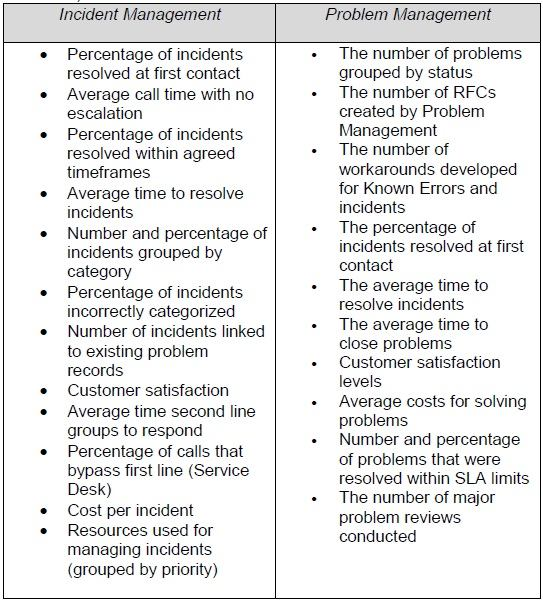
Discussions have recently been held regarding the performance of the Incident and Problem Management. There has been some confusion among IT managers as to what metrics demonstrate the quality and performance of these two processes.
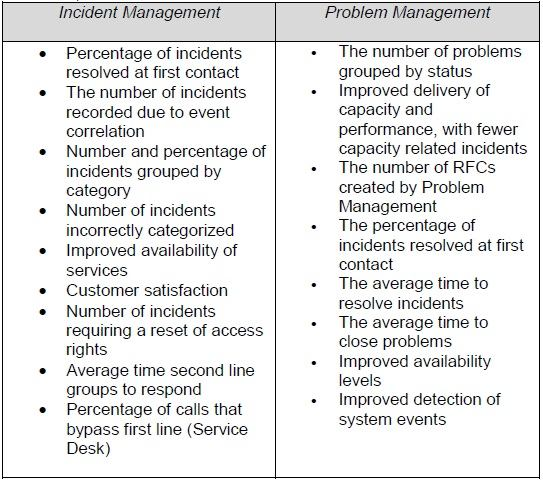
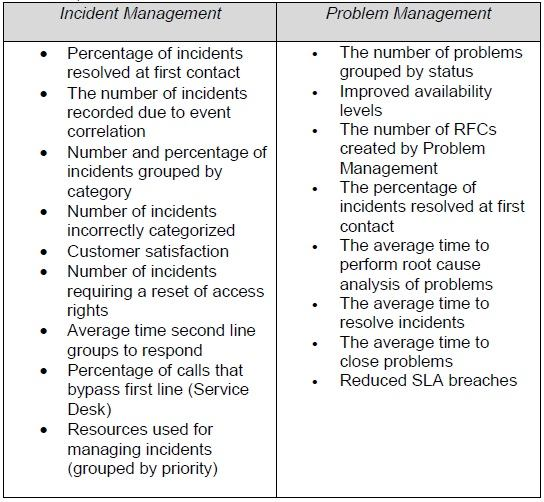
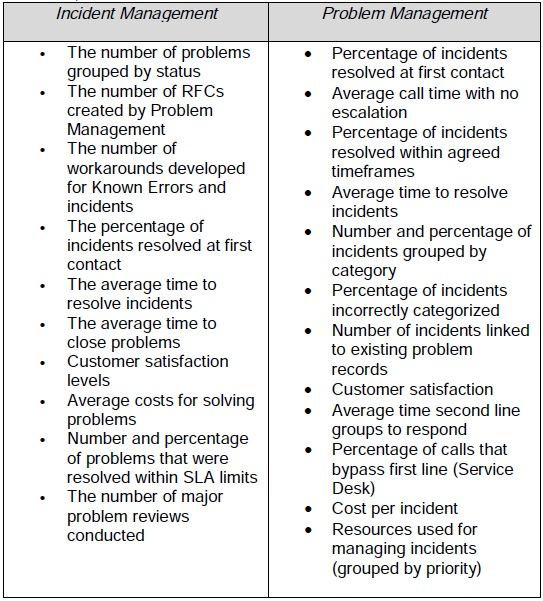
From the options below, which represents the best range of measures for evaluating the success of Incident and Problem Management?
Correct answer: D
Question 8
Scenario
Vericom is a leading provider of government, business and consumer telecommunication services, and is currently seeking ways in which to improve its utilization of IT services to drive growth across its’ multiple lines of business. One of the largest organizations in the United Kingdom, Vericom is comprised of the following business units:
- Verinet (providing ADSL, cable, 3GSM, dialup and satellite services)
- Infrastructure Services (planning, installing and maintaining the PSTN and mobile network infrastructure)
- VericomTV (Pay TV)
- Consumer Sales and Marketing (including 400 Vericom retail outlets)
- Business and Government
- Finance and Administration
- Information Technology Services (Shared Service Unit, however some business units also have their own internal service provider)
- Human Resources
- Vericom Wholesale (for wholesale of Vericom infrastructure services)
Due to the extensive scope of infrastructure deployed and large employee and customer base, Vericom continues to rely on legacy systems for some critical IT services; however this is seen as a barrier to future organizational growth and scalability of services offered. The CIO of Vericom has also raised the concern that while improvements to the technology utilized is important, this also needs to be supported by quality IT Service Management practices employed by the various IT departments.
The project of improving the IT Service Management practices employed by Vericom has been outsourced to external consultants who are aware of the major IT refresh that is going to be occurring over the next 24 months.
Refer to the scenario.
The Verinet business unit which provides internet services is currently facing increased competition from other Internet Service Providers seeking to entice Verinet customers away with offerings such as free VOIP (voice over internet protocol) and Naked DSL (unconditioned local loop). To combat this, Verinet wishes to develop a new marketing campaign highlighting the high quality and availability of services offered.
Before this occurs, the Service Manager within Verinet (who has previously implemented ITIL in other organizations) had recommended implementing Event Management to assist in the continued ability for providing high quality, highly available internet services to the UK population. She has been faced by some resistance, who believe that it is not required as Capacity, Availability, Incident and Problem Management have already been implemented.
Which of the following would be the BEST response to the Veritnet directors in describing the benefits of introducing Event Management to Verinet?
- The implementation of Event Management to complement existing ITIL processes within Verinet will have a number of significant benefits. The value to the business of implementing the process is directly seen by the following benefits:
- Improved speed for Incident and Problem Management for identifying and analyzing the cause and potential effect
- Improved ratio of used licenses against paid for licenses
- Percentage re-use and redistribution of under-utilized assets and resources Improved aliment between provided maintenance and business support
- Improvement in maintenance scheduling and management for CIs
- The implementation of Event Management to complement existing ITIL processes within Verinet will have a number of significant benefits. The value to the business of implementing the process is generally indirect, but would support an enhanced ability to provide high quality and high availability internet services by:
- Providing mechanisms for the early detection of incidents and problems before they impact customers
- Notify the appropriate staff of status changes or exceptions that so that they can respond quickly
- Providing a basis for automated operations, increasing efficiency and allowing human resources within Verinet to be better utilized
- Providing improved visibility as to the events and interactions that occur within the IT infrastructure
- Providing performance and utilization information and trends that can be used for improved capacity planning and system design
- The implementation of Event Management to complement existing ITIL processes within Verinet will have a number of significant benefits. The value to the business of implementing the process is generally indirect, but would support an enhanced ability to provide high quality and high availability internet services by:
- Providing mechanisms for the early detection of incidents and problems before they impact customers
- Developing capabilities for the monitoring of critical components of the IT infrastructure for disruptions or breach of utilization thresholds
- Automating the notification of key staff when exception events occur
- Providing improved visibility as to the events and interactions that occur within the IT infrastructure
- Reducing the time requirements of manual activities performed by IT staff as part of preventative maintenance.
- The implementation of Event Management to complement existing ITIL processes within Verinet will have a number of significant benefits. The value to the business of implementing the process is directly seen by the following benefits:
- Reduced SLA breaches
- Reduced times required for diagnosis and root-cause analysis of problems
- Reducing ratio of high priority incidents
- Reduced Mean Time to Restore (MTTR) for incidents
- Improved availability levels
- Improved delivery of capacity and performance, with fewer capacity related incidents.
Correct answer: B
Question 9
Scenario
Vision Media is an international media organization, operating various lines of business including:
- Film Production
- Television (production and delivery of their own channel in the United States VisionOne)
- Print media (including newspapers in 15 countries)
- Online Advertising
The organization has recently been restructured, and now is comprised of the following companies and departments:
- Vision Films (production of movies and television shows)
- VisionOne (television channel)
- VisionNews (coordinates all of the sub-companies involved in the delivery of printed newspapers, as well as being the centralized source of news information for all company owned media outlets)
- VisionNet (managing the online and internet businesses)
- Legal Services
- Finance and Administration
- Human Resources
- Information Technology
The organization is also actively pursuing growth in the online market, and is currently holding discussions with the leading online news provider about the possible acquisition of their company. This would increase the overall size of Vision Media by around 15%.
The Information Technology department acts as a Shared Service Unit, providing IT Services to all of sub-companies and departments, which complement some of the Internal Service Providers that also exist. The director of Information Technology has realized the need to improve the quality of services offered by implementing ITIL, and has decided to do so using a phased approach. Some of the Service Design and Service Transition processes have already been implemented, and they are now planning the implementation of Service Operation.
While the IT director does have tentative support from the other directors and CEO, budgets for implementing the Service Operation processes have not been finalized, and still require a business case to be formally submitted.
Refer to the exhibit.
The IT director is required to submit a business case to the board of directors of Vision Media for the implementation of Service Operation. Which of the following responses is the BEST summary of the benefits of implementing Service Operation (processes and functions), to be included in the business case?
- As part of the ongoing Service Management initiative within Vision Media, the implementation of Service Operation is a vital element necessary to enable service quality and reduce the overall expenditure on IT. This is because Service Operation is ultimately where the designs and optimizations introduced by IT are supported, and from an IT perspective where the actual value of IT Service Management is seen. Specific benefits delivered as a result of improved Service Operation includes:
- Increased effectiveness and efficiency in IT Service delivery and support
- Reduced operational spending on IT
- Increased customer and user satisfaction of IT services
- Improved availability and performance of agreed IT services
Given current plans for growth of Vision Media and possible acquisitions, the implementation of Service Operation is especially important to provide processes for reactively managing a growing end user population and increased scope and complexity in IT infrastructure utilized. - As part of the ongoing Service Management initiative within Vision Media, the implementation of Service Operation is a vital element necessary to further improve service quality, and to realize the value of the previous projects already completed (refer Service Design and Service Transition projects). This is because Service Operation is ultimately where the designs and optimizations introduced by IT are executed and measured, and from a business viewpoint where the actual value of IT is seen. Specific benefits delivered as a result of improved Service Operation includes:
- Increased effectiveness and efficiency in IT Service delivery and support
- Increased return on investments (ROI) into IT
- Increased value on investments (VOI) into IT
- Increased customer and user satisfaction of IT services
Given current plans for growth of Vision Media and possible acquisitions, the implementation of Service Operation processes is especially important to provide cost-effective capabilities for managing a growing end user population and increased scope and complexity in IT infrastructure utilized. - As part of the ongoing Service Management initiative within Vision Media, the implementation of Service Operation is a vital element necessary to enable service quality and reduce the overall expenditure on IT. This is because Service Operation is ultimately where the designs and optimizations introduced by IT are deployed, and from a business perspective where the actual value of IT Service Management is seen. Specific benefits delivered as a result of improved Service Operation includes:
- Fewer disruptions to agreed IT services
- Reduced operational spending on IT
- Increased job satisfaction of IT staff
- Improved availability and performance of agreed IT services
Given current plans for growth of Vision Media and possible acquisitions, the implementation of Service Operation is especially important to provide processes for reactively managing a growing end user population and increased scope and complexity in IT infrastructure utilized. - As part of the ongoing Service Management initiative within Vision Media, the implementation of Service Operation is a vital element necessary to achieve service quality and support the objectives defined for the IT department. This is because Service Operation is ultimately where the designs and optimizations introduced by IT are supported, and from a business viewpoint where the actual value of IT is seen. Specific benefits delivered as a result of improved Service Operation includes:
- Increased effectiveness and efficiency in IT Service delivery and support
- Increased return on investments (ROI) into IT
- Reduced operational spending on IT
- Increased customer and user satisfaction of IT services
Given current plans for growth of Vision Media and possible acquisitions, the implementation of Service Operation is especially important to provide cost-effective processes for managing a growing end user population and increased scope and complexity in IT infrastructure utilized.
Correct answer: B
Question 10
Scenario
Vision Media is an international media organization, operating various lines of business including:
- Film Production
- Television (production and delivery of their own channel in the United States VisionOne)
- Print media (including newspapers in 15 countries)
- Online Advertising
The organization has recently been restructured, and now is comprised of the following companies and departments:
- Vision Films (production of movies and television shows)
- VisionOne (television channel)
- VisionNews (coordinates all of the sub-companies involved in the delivery of printed newspapers, as well as being the centralized source of news information for all company owned media outlets)
- VisionNet (managing the online and internet businesses)
- Legal Services
- Finance and Administration
- Human Resources
- Information Technology
The organization is also actively pursuing growth in the online market, and is currently holding discussions with the leading online news provider about the possible acquisition of their company. This would increase the overall size of Vision Media by around 15%.
The Information Technology department acts as a Shared Service Unit, providing IT Services to all of sub-companies and departments, which complement some of the Internal Service Providers that also exist. The director of Information Technology has realized the need to improve the quality of services offered by implementing ITIL, and has decided to do so using a phased approach. Some of the Service Design and Service Transition processes have already been implemented, and they are now planning the implementation of Service Operation.
While the IT director does have tentative support from the other directors and CEO, budgets for implementing the Service Operation processes have not been finalized, and still require a business case to be formally submitted.
Refer to the exhibit.
There is some confusion as to how the process of Access Management should be designed. In particular, there is debate as to how the process should be integrated into the overall approach of IT Service Management within Vision Media. The IT director has asked for submissions from some of her staff, describing how they think Access Management should be designed.
Which of the following submissions describes the most appropriate way in which to design and implement Access Management within Vision Media?
- The design of a quality Access Management process will need to consider the current state of IT Service Management that exists within the IT department, as well as the organizational requirements of Vision Media in general. This will require interfaces to be created with:
- Information Security Management: Which is responsible for the development and renewal of security policies, guidelines and procedures, which are then executed by Access Management
- Service Level Management: Which is responsible defining the customer requirements for access to IT services
- Request Fulfillment: Access Management will often be triggered by Service Requests, taken by the Service Desk or submitted using automated and self-help mechanisms
- Change Management: Request for Changes (RFCs) will often involve modification of access rights
- Demand Management: Which will provide information as to the patterns of business that will generate requests for access.
- Outside the scope of IT Service Management, some of the interfaces that will also need to be created are:
- Human Resources: So that effective (and automated) communication exists to assist in the creation, modification, removal and audit of access rights.
- General:
- Direct requests from department managers
- Requests for enabling increased access for VIP staff
- The design of an efficient Access Management process will need to account for the existing IT Service Management processes already implemented within the IT department, as well as the Human Resource requirements of Vision Media in general. This will require interfaces to be created with:
- Information Security Management: Which is responsible for the development and renewal of security policies, guidelines and procedures, which are then executed by Access Management
- Capacity Management: Which is responsible for the design of systems and infrastructure, which are in turn supported by Access Management
- Knowledge Management: Each Knowledge base will require various levels of access to be defined and enforced.
- Change Management: Request for Changes (RFCs) will often involve modification of access rights
- Demand Management: Which will provide information as to the patterns of business that will generate requests for access
- Outside the scope of IT Service Management, some of the interfaces that will also need to be created are:
- Legal Services: So that the Legal department can verify the request for access is appropriate and lawful.
General:- Direct requests from department managers
- Requests for enabling increased access for VIP staff
- It is important that the implementation of Access Management considers a number of key interfaces with existing IT Service Management processes, as well as other business processes, to ensure success and satisfaction of its defined objectives. This includes:
- Information Security Management: Which is responsible for the development and renewal of security policies, guidelines and procedures, which are then executed by Access Management
- Availability Management: Which is responsible for the design of security systems and infrastructure, which are in turn supported by Access Management
- Request Fulfillment: Access Management will often be triggered by Service Requests, taken by the Service Desk or submitted using automated and self-help mechanisms
- Change Management: Request for Changes (RFCs) will often involve modification of access rights
- Configuration Management: Which can be used to record relationships between users and systems they can access.
- Outside the scope of IT Service Management, some of the interfaces that will also need to be created are:
- Human Resources: So that effective (and automated) communication exists to assist in the creation, modification, removal and audit of access rights.General:
- Direct requests from department managers
- Requests for enabling restricted access to contractors and external suppliers
- Access Management will need to be implemented in isolation from existing IT Service Management processes already in place at Vision Media so that its’ integrity can be ensured. The only exception to this is Information Security Management, which is responsible for the development and renewal of security policies, guidelines and procedures. Access Management uses these as formal inputs, which are then executed accordingly.
Correct answer: C
HOW TO OPEN VCE FILES
Use VCE Exam Simulator to open VCE files
HOW TO OPEN VCEX FILES
Use ProfExam Simulator to open VCEX files
ProfExam at a 20% markdown
You have the opportunity to purchase ProfExam at a 20% reduced price
Get Now!