Download AWS Certified Machine Learning Engineer - Associate.MLA-C01.ExamTopics.2026-03-20.179q.vcex
| Vendor: | Amazon |
| Exam Code: | MLA-C01 |
| Exam Name: | AWS Certified Machine Learning Engineer - Associate |
| Date: | Mar 20, 2026 |
| File Size: | 3 MB |
How to open VCEX files?
Files with VCEX extension can be opened by ProfExam Simulator.
Purchase
Coupon: TAURUSSIM_20OFF
Discount: 20%
Demo Questions
Question 1
An ML engineer needs to implement a solution to host a trained ML model. The rate of requests to the model will be inconsistent throughout the day.
The ML engineer needs a scalable solution that minimizes costs when the model is not in use. The solution also must maintain the model's capacity to respond to requests during times of peak usage.
Which solution will meet these requirements?
- Create AWS Lambda functions that have fixed concurrency to host the model. Configure the Lambda functions to automatically scale based on the number of requests to the model.
- Deploy the model on an Amazon Elastic Container Service (Amazon ECS) cluster that uses AWS Fargate. Set a static number of tasks to handle requests during times of peak usage.
- Deploy the model to an Amazon SageMaker endpoint. Deploy multiple copies of the model to the endpoint. Create an Application Load Balancer to route traffic between the different copies of the model at the endpoint.
- Deploy the model to an Amazon SageMaker endpoint. Create SageMaker endpoint auto scaling policies that are based on Amazon CloudWatch metrics to adjust the number of instances dynamically.
Correct answer: D
Question 2
A company stores time-series data about user clicks in an Amazon S3 bucket. The raw data consists of millions of rows of user activity every day. ML engineers access the data to develop their ML models.
The ML engineers need to generate daily reports and analyze click trends over the past 3 days by using Amazon Athena. The company must retain the data for 30 days before archiving the data.
Which solution will provide the HIGHEST performance for data retrieval?
- Keep all the time-series data without partitioning in the S3 bucket. Manually move data that is older than 30 days to separate S3 buckets.
- Create AWS Lambda functions to copy the time-series data into separate S3 buckets. Apply S3 Lifecycle policies to archive data that is older than 30 days to S3 Glacier Flexible Retrieval.
- Organize the time-series data into partitions by date prefix in the S3 bucket. Apply S3 Lifecycle policies to archive partitions that are older than 30 days to S3 Glacier Flexible Retrieval.
- Put each day's time-series data into its own S3 bucket. Use S3 Lifecycle policies to archive S3 buckets that hold data that is older than 30 days to S3 Glacier Flexible Retrieval.
Correct answer: C
Question 3
A credit card company has a fraud detection model in production on an Amazon SageMaker endpoint. The company develops a new version of the model. The company needs to assess the new model's performance by using live data and without affecting production end users.
Which solution will meet these requirements?
- Set up SageMaker Debugger and create a custom rule.
- Set up blue/green deployments with all-at-once traffic shifting.
- Set up blue/green deployments with canary traffic shifting.
- Set up shadow testing with a shadow variant of the new model.
Correct answer: D
Question 4
An ML engineer is using a training job to fine-tune a deep learning model in Amazon SageMaker Studio. The ML engineer previously used the same pre-trained model with a similar dataset. The ML engineer expects vanishing gradient, underutilized GPU, and overfitting problems.
The ML engineer needs to implement a solution to detect these issues and to react in predefined ways when the issues occur. The solution also must provide comprehensive real-time metrics during the training.
Which solution will meet these requirements with the LEAST operational overhead?
- Use TensorBoard to monitor the training job. Publish the findings to an Amazon Simple Notification Service (Amazon SNS) topic. Create an AWS Lambda function to consume the findings and to initiate the predefined actions.
- Use Amazon CloudWatch default metrics to gain insights about the training job. Use the metrics to invoke an AWS Lambda function to initiate the predefined actions.
- Expand the metrics in Amazon CloudWatch to include the gradients in each training step. Use the metrics to invoke an AWS Lambda function to initiate the predefined actions.
- Use SageMaker Debugger built-in rules to monitor the training job. Configure the rules to initiate the predefined actions.
Correct answer: D
Question 5
An ML engineer needs to use data with Amazon SageMaker Canvas to train an ML model. The data is stored in Amazon S3 and is complex in structure. The ML engineer must use a file format that minimizes processing time for the data.
Which file format will meet these requirements?
- CSV files compressed with Snappy
- JSON objects in JSONL format
- JSON files compressed with gzip
- Apache Parquet files
Correct answer: D
Question 6
A company is planning to create several ML prediction models. The training data is stored in Amazon S3. The entire dataset is more than 5 ТВ in size and consists of CSV, JSON, Apache Parquet, and simple text files.
The data must be processed in several consecutive steps. The steps include complex manipulations that can take hours to finish running. Some of the processing involves natural language processing (NLP) transformations. The entire process must be automated.
Which solution will meet these requirements?
- Process data at each step by using Amazon SageMaker Data Wrangler. Automate the process by using Data Wrangler jobs.
- Use Amazon SageMaker notebooks for each data processing step. Automate the process by using Amazon EventBridge.
- Process data at each step by using AWS Lambda functions. Automate the process by using AWS Step Functions and Amazon EventBridge.
- Use Amazon SageMaker Pipelines to create a pipeline of data processing steps. Automate the pipeline by using Amazon EventBridge.
Correct answer: D
Question 7
An ML engineer needs to use AWS CloudFormation to create an ML model that an Amazon SageMaker endpoint will host.
Which resource should the ML engineer declare in the CloudFormation template to meet this requirement?
- AWS::SageMaker::Model
- AWS::SageMaker::Endpoint
- AWS::SageMaker::NotebookInstance
- AWS::SageMaker::Pipeline
Correct answer: A
Question 8
A company wants to improve the sustainability of its ML operations.
Which actions will reduce the energy usage and computational resources that are associated with the company's training jobs? (Choose two.)
- Use Amazon SageMaker Debugger to stop training jobs when non-converging conditions are detected.
- Use Amazon SageMaker Ground Truth for data labeling.
- Deploy models by using AWS Lambda functions.
- Use AWS Trainium instances for training.
- Use PyTorch or TensorFlow with the distributed training option.
Correct answer: AD
Question 9
An ML engineer needs to use an Amazon EMR cluster to process large volumes of data in batches. Any data loss is unacceptable.
Which instance purchasing option will meet these requirements MOST cost-effectively?
- Run the primary node, core nodes, and task nodes on On-Demand Instances.
- Run the primary node, core nodes, and task nodes on Spot Instances.
- Run the primary node on an On-Demand Instance. Run the core nodes and task nodes on Spot Instances.
- Run the primary node and core nodes on On-Demand Instances. Run the task nodes on Spot Instances.
Correct answer: D
Question 10
A company has trained an ML model in Amazon SageMaker. The company needs to host the model to provide inferences in a production environment.
The model must be highly available and must respond with minimum latency. The size of each request will be between 1 KB and 3 MB. The model will receive unpredictable bursts of requests during the day. The inferences must adapt proportionally to the changes in demand.
How should the company deploy the model into production to meet these requirements?
- Create a SageMaker real-time inference endpoint. Configure auto scaling. Configure the endpoint to present the existing model.
- Deploy the model on an Amazon Elastic Container Service (Amazon ECS) cluster. Use ECS scheduled scaling that is based on the CPU of the ECS cluster.
- Install SageMaker Operator on an Amazon Elastic Kubernetes Service (Amazon EKS) cluster. Deploy the model in Amazon EKS. Set horizontal pod auto scaling to scale replicas based on the memory metric.
- Use Spot Instances with a Spot Fleet behind an Application Load Balancer (ALB) for inferences. Use the ALBRequestCountPerTarget metric as the metric for auto scaling.
Correct answer: A
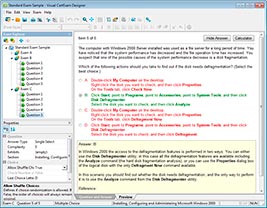
HOW TO OPEN VCE FILES
Use VCE Exam Simulator to open VCE files
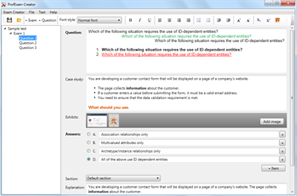
HOW TO OPEN VCEX FILES
Use ProfExam Simulator to open VCEX files
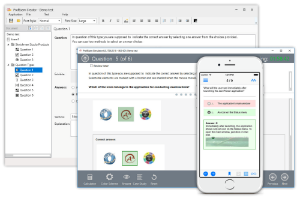
ProfExam at a 20% markdown
You have the opportunity to purchase ProfExam at a 20% reduced price
Get Now!